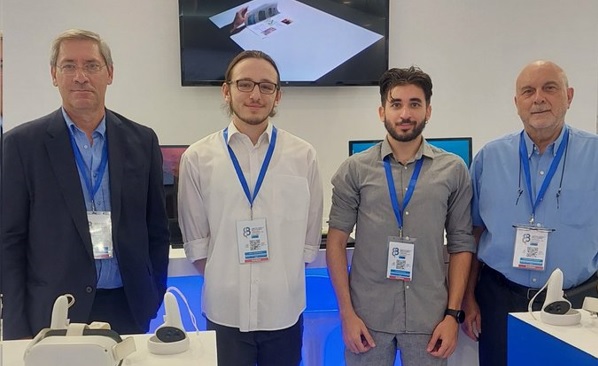
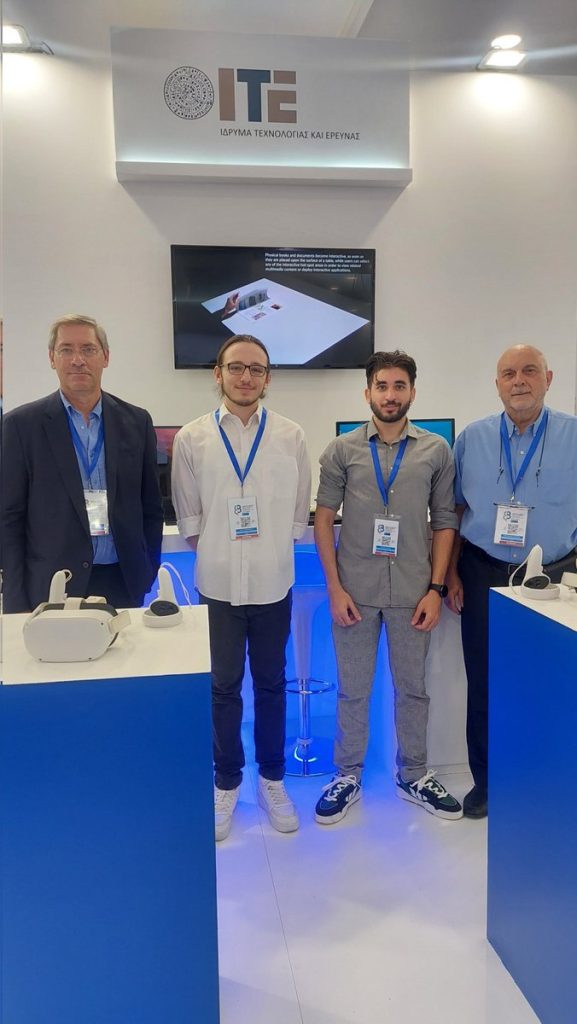
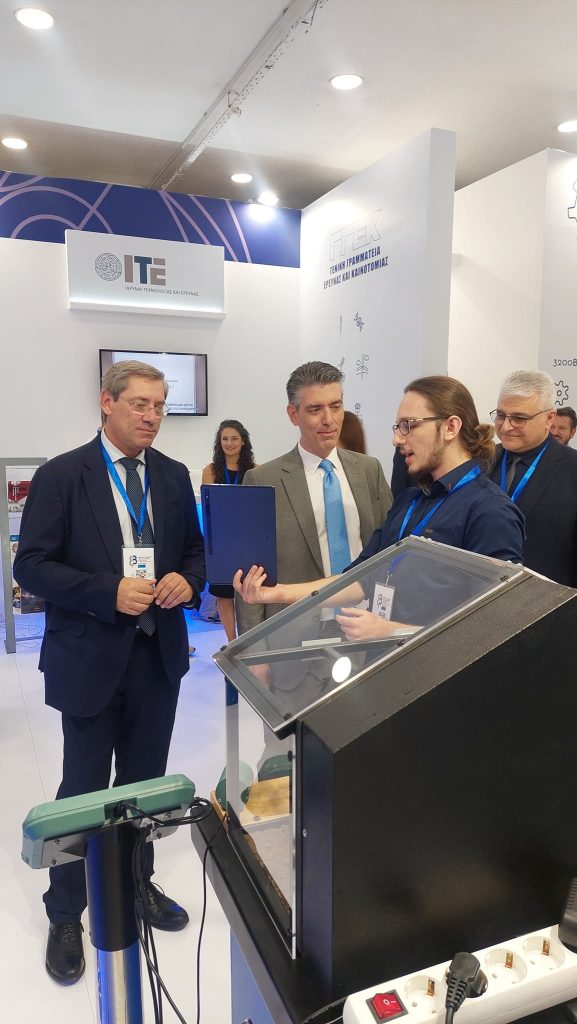
Τhessaloniki International Fair (TIF) is Greece’s largest annual trade fair open to the general public and is held every year in September. FORTH-ICS was invited to participate in the General Secretariat for Research and Technology booth, presenting the following applications: VR Treasure Hunt, Stories from the city of Heraklion in a Virtual Reality (VR) environment and Intelligent Greenhouse.
- VR Treasure Hunt: An interactive treasure hunt game, where the user is called to navigate the virtual reality world and to solve a series of puzzles related to history, cultural heritage, events (e.g., periodical exhibitions), monuments, morals and customs of the city of Heraklion. The purpose is to highlight the selected 360° routes, as well as to connect them in such a way as to stimulate the user’s interest in extracting historical data related to the city.
- Stories from the city of Heraklion in a Virtual Reality (VR) environment: Through the application, users have the opportunity to travel through space and time, since within the virtual reality environment they are able to learn about the history of the city of Heraklion by moving freely in selected 3D set ups. It is not only a playful, but also an educational application that offers a realistic visualization of 3D spaces and monuments, accompanied by original storytelling drawn mainly from the past of the city of Heraklion.
- Intelligent Greenhouse: The Intelligent Greenhouse is a small-scale experimental prototype that integrates various technologies to act as an intelligent cultivation space. In particular, an extensive network of sensors and actuators monitors the internal and external environmental conditions (e.g., soil temperature and moisture, air, solar radiation, weather conditions) along with specific growth parameters of vegetables (e.g., weight of growing produces) and permits the remote management. In parallel, sophisticated agronomic scenarios automatically adjust the internal environmental conditions to ensure optimal growth of each plant, while advanced mechanisms based on machine learning detect unwanted changes in the greenhouse’s microclimate and common problems (e.g., diseases, technical failures).